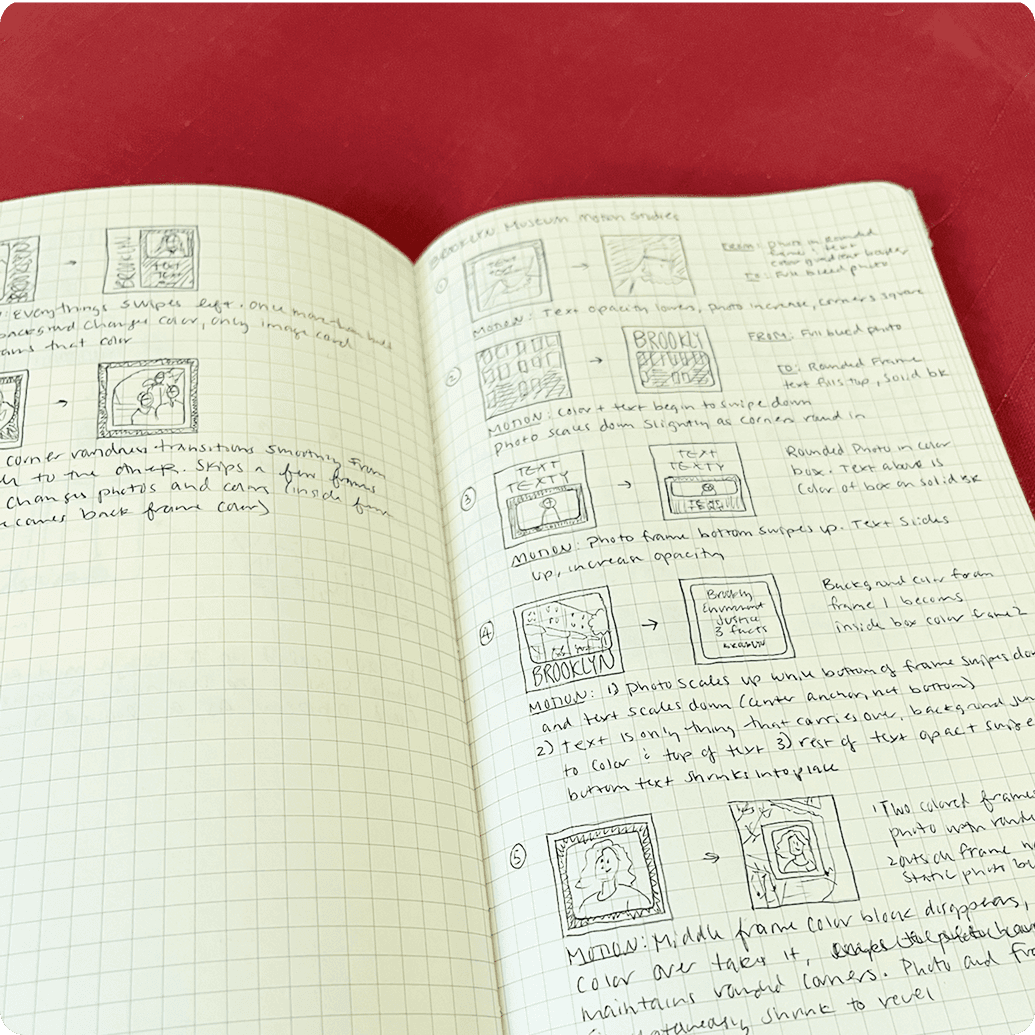
Thinking v. executing
In a deadline and revenue-driven environment, it's too rare that designers, writers, and strategists are given the bandwidth to truly create the highest quality work.
Time spent thinking — away from the desk, outside, on paper, in workshops or brainstorm sessions — are cut short (or cut completely) to get deliverables out the door faster.
Strategy — at a company-wide scale, audience level, and campaign level — is present at every touchpoint, every visual, every word choice.
Even the simplest graphic needs to ladder back up to mission. Not only will this do wonders for brand recognition, loyalty and trust, but may even transform something "salesy" into something that reaches people at a human, intellectual, or emotional level.
Stepping away
Thinking creatively and conceptually is a muscle — the more you practice ideating and iterating, the easier the process becomes.
It’s easy to get stuck in one's own visual preferences, or dive straight into an idea you're sure will work well without exploring alternatives.
And it's true, we don't always have the luxury of time to start with the pencil on each assignment. But figuring out which projects deserve time and attention and creating space around them feels as though it's beginning to be a lost art.
It’s important to dedicate time in our daily schedules to separate thought from action. Often times, this means removing myself from my desk and computer, and to spend time in an analog world for a while. I believe a change of environment can trigger our brains to think differently, and can make us better creators once we return to the screen.
It can be hard to pull yourself away from your desk, when you're constantly being messaged and needed. And even when we do step away, it's all too frequent we spend that time on our phones instead of truly taking a break.
Brainstorming for fun
Brainstorming doesn’t always have its place in day-to-day projects for work. Coming up with new ideas “off the clock” allows us to re-associate our creativity with having fun. It might allow you to take your own ideas less seriously and spur more out-of-the-box thinking.
These “just for fun” projects may end up influencing the work you do for your job. You might find yourself more willing to play with different ideas before jumping into one you know you like. You might question yourself more, look at things from different angles, or even be more open to coworkers’ suggestions.
Brainstorming asks you to search the far corners of your mind, for images, words and associations. It asks you to transport yourself into your targeted consumer, or even into the product itself.
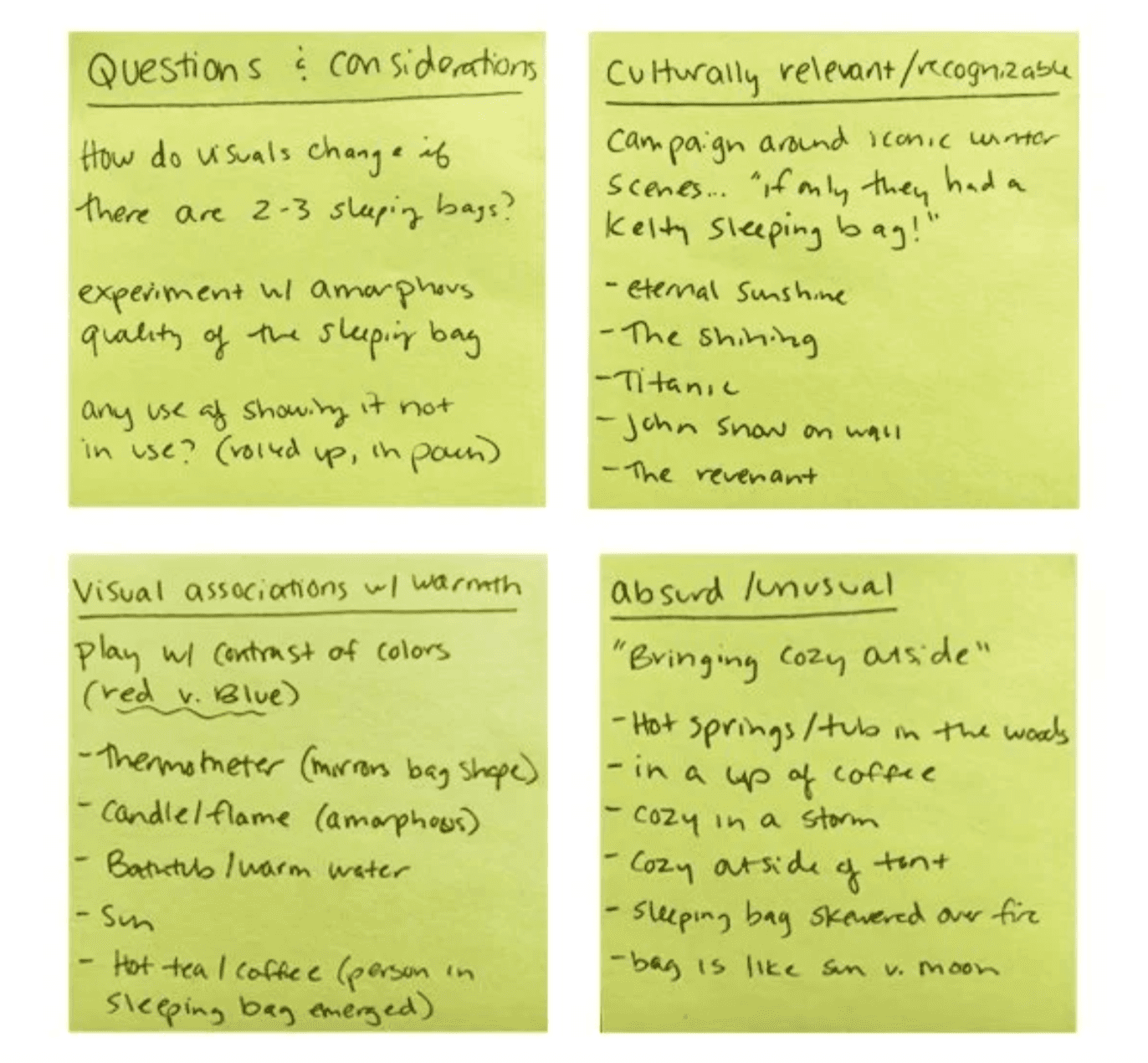
Why iterate?
Did you have one of those college professors that asked you to draw 50 thumbnails for one idea? It’s a painful process, I know. But what if you didn’t do 50, what if you drew 20, or 10. What if they weren’t all drawn out, but some were just written? Would it feel more doable?
Coming up with as many ideas as possible for a single concept forces you to think through all preexisting associations. It pushes you to dive into research. It begs you to consider all five senses, your life experiences, stereotypes and assumptions, shapes and colors and wordplay.
It’s the process of going deep into an idea — of taking something simple and making it complex, so when you simplify it again, it seems effortless, clever, relevant and purposeful.
Even if you love your first idea, the iterative process is a way to validate the strength of that concept.
Time dedicated to thought and exploration is never wasted.

The brainstorming process
So what does the brainstorming process look like?
Everyone has their own process for coming up with ideas. Usually I’ll write out a whole page of notes before drawing a single thumbnail. Jotting them down preserves the thought faster than I can sketch.
At the campaign level, I’ll think through visuals that I associate with the product or idea. I’ll think of some funny examples, others that feel culturally relevant, and some that feel genuine and endearing.
It’s harder than you’d expect to push yourself away from obvious solutions — but that’s when you might land on something truly innovative.